Ethiopia: An Unbroken History
To say Ethiopia is rich in history and culture would be an understatement. Ethiopia is literally the cradle of humankind, with human ancestral fossils unearthed stretching nearly 6 million years. It's Africa's oldest independent country and its second most populous, home to over 130 million people, 80 ethnic groups and around 100 languages. Not for a lack of military effort by European empires, but Ethiopia has stayed under its own rule for the whole of its recorded history bar one brief and fiercely resisted occupation. And for all you coffee drinkers, well you can credit the region for that too. So grab a cup as we get into the country's remarkable history.
Aksum: An Empire Built on Trade

Obelisk at Aksum, An obelisk from the ancient Ethiopian kingdom of Aksum.
Wind the clock back to the first centuries CE and Aksum was already a heavyweight. The Kingdom of Aksum ran its economy through the Red Sea port of Adulis, moving ivory, gold, tortoiseshell and frankincense out to Rome, Persia and India, and bringing back wine, glassware, spices and fine textiles in return. A Greek merchant's guide to Indian Ocean trade written around this time, the Periplus of the Erythraean Sea, describes Adulis as a working harbour crowded with foreign traders.
By the third century, the Persian prophet Mani ranked Aksum among the four great powers of the world, alongside Rome, Persia and China. Aksum backed that trade with its own gold, silver and bronze coinage and a capital built to match, palaces and stelae carved from single blocks of stone reaching over twenty metres into the sky. It was just one of Africa's great ancient kingdoms, each with an empire-building story of its own.
Faith Across Ethiopia
Around 330 CE, King Ezana converted the Aksumite court to Christianity, making Aksum one of the earliest Christian states anywhere, decades ahead of Rome's own adoption of Christianity as an official state religion. Ethiopian Orthodox tradition holds that the Ark of the Covenant sits inside Aksum's Church of St Mary of Zion, delivered there, so the story goes, by Menelik I, son of King Solomon and the Queen of Sheba. Fact or legend, that lineage became the founding myth of Ethiopian kingship for nearly two millennia.
Islam reached Ethiopia early too, with some of the Prophet Muhammad's followers fleeing persecution in Mecca for sanctuary in the Christian kingdom of Aksum. And in the highlands around Lake Tana, the Beta Israel, an Ethiopian Jewish community whose roots some trace to that same Solomonic line, lived largely apart from the rest of the Jewish world for centuries. Between 1984 and 1991, most of them were airlifted to Israel across three covert missions, Operation Moses, Joshua and Solomon.
Medieval Dynasties and the Imperial Era
By the twelfth century, the Zagwe dynasty had shifted Ethiopia's centre of power south from Aksum to Lasta, where King Lalibela commissioned eleven churches carved downward out of solid volcanic rock, structures still standing and still in active use as places of worship. Around 1270, Yekuno Amlak overthrew the last Zagwe king and founded the Solomonic dynasty, which ruled Ethiopia for roughly seven centuries. Its clearest legacy is Gondar, made imperial capital in the 1630s, where, under the patronage of rulers including Empress Mentewwab and her son Iyasu II, the Second Gondarine style emerged, an ornate tradition of manuscript illumination, icons and church painting
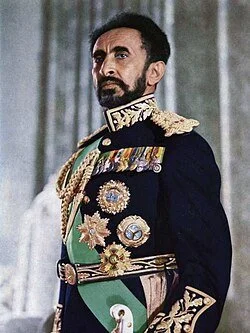
Haile Selassie I
Holding the Line Against Empire
By the late nineteenth century, Europe had decided Africa was there for the taking. Italy tried its luck on Ethiopia, pushing a treaty it had deliberately mistranslated to suggest Emperor Menelik II had signed away sovereignty to an Italian protectorate. Thankfully, the Emperor had his suspicions on the interpretation. When Italy pressed the point with force, Menelik answered with roughly 100,000 troops, an army that included soldiers raised by his wife, Empress Taytu, and by regional governors like Ras Makonnen, father of the future Haile Selassie. On 1 March 1896, at the Battle of Adwa, that force handed the Italian army a comprehensive beating, and Italy signed a new treaty recognising Ethiopian sovereignty outright.
Forty years of peace followed before Mussolini tried again in 1935, this time with tanks, aircraft and chemical weapons outlawed under international law. Haile Selassie, crowned emperor in 1930, fled into exile and stood before the League of Nations in Geneva, the first head of state ever to address the body in person. "It is us today," he told them. "It will be you tomorrow." Ethiopian resistance fighters, backed eventually by British forces, drove the Italians out in 1941, and Selassie returned to Addis Ababa that May.
Addis Ababa

The African Union's headquarters building in Addis Ababa, Ethiopia.
Selassie spent the decades that followed turning Ethiopia into a hub for African unity. The UN Economic Commission for Africa set up shop in Addis Ababa in 1958, and five years later the Organisation of African Unity chose the same city for its founding, a deliberate signal that Ethiopia stood as living proof colonisation had never been the only path available to the continent. The African Union still has its headquarters in Addis Ababa today.
Ethiopian Culture
The coffee plant itself, Coffea arabica, is native to Ethiopia's highland forests, where it still grows wild. Legend has it was discovered by a goatherder in 800 A.D. Coffee still makes up around 60 percent of Ethiopia's export earnings today. In the region, the ceremony of roasting, brewing, and drinking coffee is a daily ritual.
Now on to Ethiopian cuisine, which has in recent years become a real love of foodies. For anyone that’s watched Insecure, you’ll remember the high tension season 4 finale with Issa and Molly at the Merkato Ethiopian Restaurant & Market located in Los Angeles's Little Ethiopia neighborhood, reconciling their friendship over some Injera and stew.
Ethiopia runs seven to eight years behind the rest of the world, its solar-based calendar puts the country in what is technically 2018. It remains central to the country's religious life, with two of its most spectacular celebrations being Timkat, the Orthodox celebration of Epiphany, and Meskel, on the finding of the True Cross. Both are celebrated by processions, chanting and rituals that have been passed down through generations
Ethiopia's story holds all of it at once, in a really unique way - mythology tangled up with real ancient civilization, an imperial era that ran for the best part of seven hundred years, and a cultural depth that spans cuisine, festivities, religion and language.