What is Afrofuturism?
In recent times Afrofuturism has become synonymous with the Black Panther film franchise. A groundbreaking film that completely subverts deeply entrenched historical, cultural, and cinematic tropes. Wakanda is portrayed as the most advanced technological country in the world, an African nation that was never colonised and where traditions are preserved. Wakanda, is a Utopia. This is Afrofuturism.
What is Afrofuturism?
It is a cultural aesthetic and movement that started in America, reimagining and exploring worlds that draw on African traditions, history, folklore, tech, mysticism and fantasy. Afrofuturism is an alternate empowering and liberated Black experience through a speculative lens, which asks “what if”.
Culture critic Mark Dery coined the term Afrofuturism in his essay "Black to the Future" in 1994, where he interviewed Black sci-fi writers, Samuel R. Delany Greg Tate and Tricia Rose. In the piece, the term is defined as "speculative fiction that treats African American themes and addresses African American concerns in the context of the twentieth century technoculture, and, more generally, African American signification that appropriates images of technology and a prosthetically enhanced future."
Coining the term is as far as Dery’s credit goes for a movement that was already well established in the culture, and expressed innovatively and creatively through film, literature, music, fashion and art.
Where it began: the literary roots
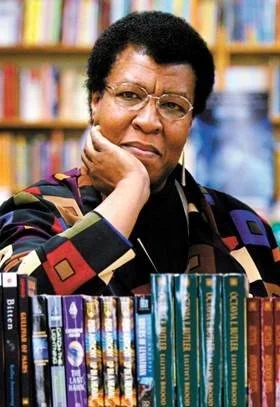
Octavia Butler
One of the earliest pieces of work, widely cited as the forerunner to Afrofuturism, is the poem “On Imagination” by Phillis Wheatley published in 1773, where she writes "We on thy pinions can surpass the wind, / And leave the rolling universe behind.” In the poem the mind becomes a sanctuary for envisioning complete freedom and alternate realities.
W.E.B. Du Bois used the apocalypse to make his point in "The Comet" (1920): a Black man and a white woman turn out to be the only survivors of a gas cloud that's wiped out New York, and the racial rules that kept them apart stop applying overnight.
But you will probably be more familiar with the works of writer Octavia Butler, considered the “Mother” of Afrofuturism. At age 12, Butler watched the 1954 sci-fi film Devil Girl from Mars. She realized she could write a better story herself and with a lack of representation in the genre, Butler also wanted to write herself in it.
And of course, she did, prolifically. Kindred, published in 1979, drags a modern Black woman back through time to antebellum Maryland, forcing her to survive as a slave in order to secure her own existence. Butler goes on to build a body of work that made her the first science fiction writer of any race to win a MacArthur "genius" grant.
Sun Ra and the sound of the cosmos
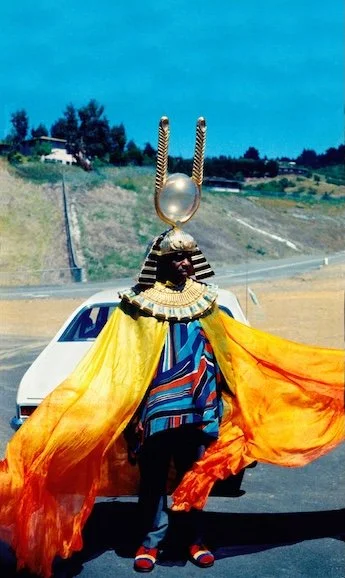
Sun Ra
Sun Ra, the “Godfather” of Afrofuturism, was an out of this world, avant-garde jazz musician and portrayed himself as such. The African-American experience influenced his music and persona. He considered earth to be a place of hostility for Black people, outer space and Egyptian mythology became a metaphor for freedom and liberation.
The music industry wasn't ready for his vision, so Sun Ra created his own independent label, El Saturn Records, releasing songs such as Rocket Number Nine Take Off for the Planet Venus (1960) and Space is the Place (1973) . In 1974 his vision reached the screen in Space Is the Place. Part science fiction, part musical journey, the film follows Sun Ra as he travels through the cosmos, searching for a new home for the Black diaspora beyond the racism and restrictions of Earth.
George Clinton was heavily influenced by Sun Ra. His bands Parliament and Funkadelic merged to become P Funk creating the concept album Mothership Connection, which was Black people leaving earth for space to find liberation in space. He’s quoted as saying "Afronauts, capable of funkitizing galaxies". The Mothership Connection tour remains one of the most iconic live shows of all time landing a literal spaceship on stage, building an entire cosmology around funk.
Afrofuturism in hip-hop, reggae & RnB
OutKast, as the name suggests, Big Boi and Andre 3000 felt like outcasts and misfits first within school, then the hip hop community. They leaned into their difference, embracing the idea of being terrestrial outsiders on their critically acclaimed album ATLiens in 1996.
In reggae, Lee "Scratch" Perry, was a foundational Afrofuturist artist who also referred to himself as an extraterrestrial, and would dress in space-print coats covered in moons and stars. He recorded songs such as "Return of Django" (1969) and "Disco Devil" (1977) with his signature mix of heavy bass, echoing space, and raw analog distortion from his Black Ark studio in Kingston. His music influenced the likes of Afrika Bambaataa
Janelle Monáe features her android alter-ego Cindi Mayweather on albums including Metropolis and Dirty Computer exploring intersectional themes of race, gender, and queer identity.
Afrofuturism in Art
Jean-Michel Basquiat work merged ancestral African cultural memory, modern technoculture, and speculative critiques of racial history. Basquiat was an Afrofuturist artist. He filled his canvases with crowns, tribal heads, skeletons, Egyptian hieroglyphs and diagrams, selling for a few million dollars up to a record-breaking $110.5 million. Basquiat’s art was a commentary of the Black experience and rewired how we look at the history of race and power. He put Black figures inside systems of knowledge and power that art history had rarely let them occupy before.
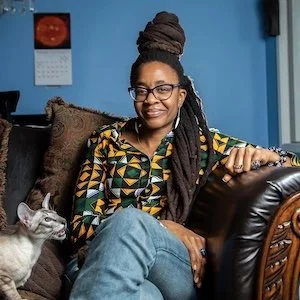
Nnedi Okorafor
One man's trash is another man's treasure. The eccentric Kenyan sculptor Cyrus Kabiru uses trash from all over the world to innovatively create elaborate art. His iconic C-Stunners series blends the fanciful with social commentary out of scrap metal, bottle tops, turning waste into something closer to armour.
Afrofuturism Today
Afrofuturism has evolved beyond its African American roots and subversive aesthetic expressions into a global mainstream phenomenon. The movement is expressed widely across the African diaspora and has taken on new interpretations from costumes at the Notting Hill Carnival to bold sculptures exhibited in galleries all over the world. And now, there’s even a subculture created by author Nnedi Okorafor called African Futurism, which centres sci-fi storytelling on the continent.