Liberia, the Paradox of Africa's First Republic
In 1847, a group of formerly enslaved and free-born African Americans declared Liberia the first republic in Africa. Liberia was America’s first and only African colony and its history, from how it came to exist, to what followed is deeply complex and honestly, bizarre.
A Colony Built to Solve America's Problem
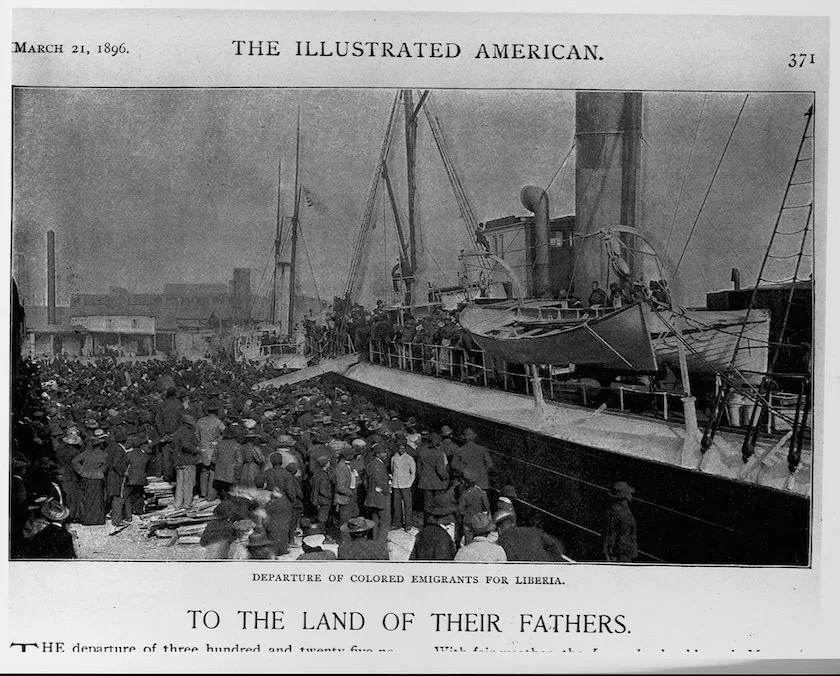
Elizabeth (later called the "Mayflower of Liberia")
Liberia's story was born from a dilemma that afflicted white Americans trying to figure out what to do with the growing population of free African Americans. Southern planters feared free African Americans would inspire the enslaved population to revolt, jeopardising their brutal economic system and in the North white abolitionists didn’t feel like African Americans would excel in a society steeped in racism. In December 1816, a small group of white men from the North and South, including the minister Robert Finley and the politician Henry Clay, met in Washington, D.C., and formed the American Colonization Society.
Veiled as a humanitarian project, their plan culminated on the West African coast at Cape Mesurado. Armed with trade goods and backed by literal gunpoint intimidation, the American Colonization Society coerced indigenous chiefs into surrendering their land. With the treaty forced through, the American Colonization Society began shipping free-born and newly emancipated African Americans across the Atlantic to build a new colony. The new settlers, known as the Americo-Liberians called it Christopolis. They renamed it Monrovia in 1824, after President James Monroe, who had helped fund the project.
The early years were brutal. Disease killed settlers by the thousand. Communities already living on that land, who had watched it handed over at gunpoint, fought as much as they could to defend it. And still the ships kept coming. Between 1822 and the American Civil War, roughly 15,000 African Americans made the crossing to Liberia, alongside thousands more Africans freed from illegal slave ships by US Navy patrols.
Americo-Liberians as the Ruling Class
The Americo-Liberians instantly became the ruling class over the indigenous people, who were living sustainable lives as traders before the hostile takeover. They built grand southern style plantation homes and even dressed as Europeans, in heavy fabric completely unsuitable for the sweltering climate. English was the primary language, spoken with an American accent, which still lingers to this day. And to maintain their social class and distinct cultural identity they only married amongst themselves.
The Push for Independence
For over two decades, Liberia was governed by and answered to the American Colonization Society, an ocean away in Washington. By the mid-1840s, the project was bankrupt, collapsing under its own fragility and contradictions. Joseph Jenkins Roberts was front and centre of pushing for change.
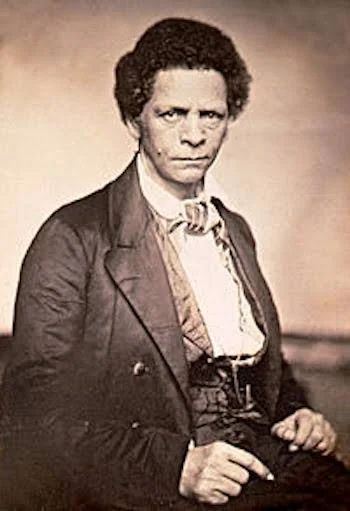
Joseph Jenkins Roberts
Roberts had arrived in Liberia as a young settler from Virginia and rose through the colonial administration to become its first Black governor in 1841. He inherited a genuine problem: because Liberia wasn't recognised as a sovereign state, it had no legal power to enforce its own trade laws. British merchants simply ignored Liberian customs duties. There was no real country to answer to, so why would they? Roberts pushed Liberia's legislature towards the only fix available: declare independence outright, and force the world to treat Liberia as a nation rather than an outpost.
On 5 July 1847, twelve delegates convened in Monrovia, representing the Commonwealth's three counties: Samuel Benedict, Hilary Teage, Elijah Johnson, John Newton Lewis, Beverly R. Wilson and John B. Gripon for Montserrado; John Day, Amos Herring, Anthony W. Gardiner and Ephraim Titler for Grand Bassa; Richard E. Murray for Sinoe. Benedict chaired the convention, and Jacob W. Prout served as secretary. Teage, a settler and newspaper editor, is credited with drafting the declaration itself, and on 26 July 1847 the convention finalised it. Liberia became the first republic in Africa, and the second Black republic in the world after Haiti. Roberts was elected the republic's first president and took office in January 1848.
Here's the paradox. The declaration these twelve men produced was not a modest document. It read as both a moral case for Black self-government and a blueprint for inventing something entirely new: a single Liberian people, out of settlers still carrying the scars and habits of America, and a majority population who had never asked to be governed by them. The motto adopted alongside the declaration was "The love of liberty brought us here." They called themselves "the representatives of the people of the Commonwealth of Liberia." In truth, they were twelve relatively prosperous settler men speaking for a country whose actual population they had barely consulted. Familiar? The American Declaration of Independence made grand claims about the equality of man while its signatories owned other men outright and dismissed indigenous peoples as savages. And of course there was slavery. Liberia's founders, not even several generations removed from bondage themselves, wrote their own version of that same unresolved promise.
Recognition of an independent Liberia took time and travel. Roberts spent much of his first term abroad, courting European governments in person. Britain recognised Liberia in 1848, France not long after. The United States, the country whose colonisation project had built Liberia in the first place, refused to recognise its independence until 1862, in the middle of its own war over slavery.
An Oddity in a Nineteenth-Century World
Liberia was founded into a nineteenth-century world still organised almost entirely around white global power. It sat alongside a handful of defiant counterparts, revolutionary Haiti and the ancient empire of Ethiopia among them, neither of them tidy or uncomplicated symbols of Black self-rule either. From Liberia's first year, it was squeezed by internal division and by outside powers with their own interests in keeping a young Black republic weak. All of this followed Liberia for the rest of its history: through the Americo-Liberian century of True Whig Party rule, through the 1980 coup that finally ended it, and into the civil wars that followed.
Today, Liberia is in its longest period of peace since 1989, and rebuilding. Much of that is down to the leadership of Ellen Johnson Sirleaf, who in 2005 became the first woman elected to lead an African nation, in a country still finding out what the love of liberty could mean for everyone in it, not just the twelve men who first put it into words.