The Life of Claudia Jones
Claudia Jones spent less than a decade in Britain, and in that decade she founded the country's first major Black newspaper, staged its first televised Caribbean carnival, and built a political base that outlasted her by generations. Before any of that, she had already sat on the national leadership of the American Communist Party as its only Black woman, published a founding text considered as a precursor to intersectional feminism, been arrested more than once and tried under the Smith Act, and been deported from the only country she'd known since childhood, all before she landed in London in 1955, aged forty.
Harlem and Communism
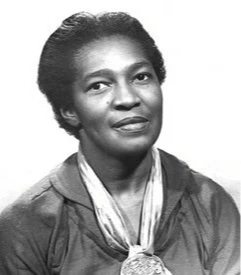
Claudia Vera Cumberbatch was born in Port of Spain, Trinidad, in 1915 and moved to Harlem at eight, arriving into a neighbourhood in the middle of its own cultural renaissance, its churches, jazz clubs and street-corner politics running alongside the poverty that also shaped daily life there. Tuberculosis interrupted her schooling for nearly a year in adolescence, a condition that would trouble her health for the rest of her life. Barred from college by her immigration status rather than her ability, she worked in a laundry and started writing a column, “Claudia Comments,” for a local Harlem paper.
In 1936, she was drawn into activism through the campaign to free the Scottsboro Boys, nine Black teenagers wrongly convicted of rape in Alabama on the testimony of two white women, a case that became a rallying point for the American left and a proving ground for a generation of young Black organisers. Jones joined the Young Communist League through that campaign and never really left political organising again. She joined the Daily Worker's editorial staff in 1937 and became editor of the Young Communist League's Weekly Review the following year, and by 1945 had been elected to the Communist Party USA's National Committee, the only Black woman to sit on its leading body. She ran in the same Black Left circles as Paul and Eslanda Robeson, W.E.B. Du Bois and Harry Belafonte, and formed two of the defining relationships of her political life: a close friendship with the labour organiser Elizabeth Gurley Flynn, and Paul Robeson that would outlast her move to Britain. In 1949 she published An End to the Neglect of the Problems of the Negro Woman, laying out the case that Black women experienced a distinct, compounded form of exploitation under capitalism, an argument for what would later be named intersectionality.
Arrest and Deportation
That National Committee seat made her a marked figure. She was arrested more than once from 1948 onward under the Smith Act, a law originally passed in 1940 that made it a federal crime to advocate the violent overthrow of the US government, and which McCarthy-era prosecutors used almost exclusively against Communist Party leadership. In 1951, while in prison at thirty-six, she suffered her first heart attack. That same year she stood trial alongside Elizabeth Gurley Flynn and other Communist Party leaders, convicted under the Smith Act for alleged conspiracy to advocate revolutionary change rather than any act of violence. The Supreme Court declined to hear their appeal. In December 1955, having spent thirty-one of her forty years in the country, she was deported anyway, classified on paper as a British subject by virtue of her Trinidadian birth, a technicality that sent her to London rather than to a Caribbean she had not lived in since childhood.
Claudia Jones Launches First Major Black Newspaper
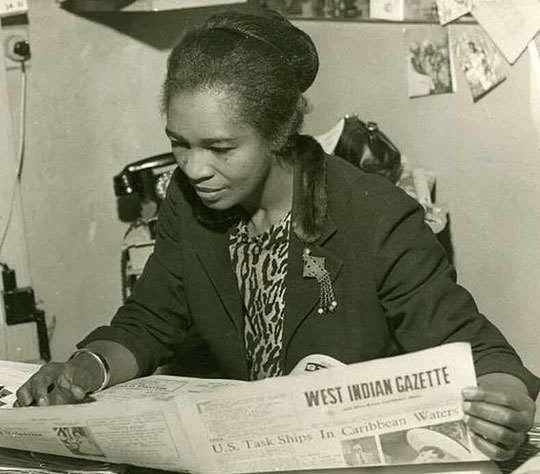
She sailed into Britain and arrived hoping to continue her political work with British Communists but soon encountered racism and suspicion. So she built her own base. Her cousin Trevor Carter and friends including Amy Ashwood Garvey, Beryl McBurnie and Pearl Prescod became her closest UK collaborators, while Robeson continued advising from a distance. In March 1958, from an office above a barber's shop on Brixton Road, she founded the West Indian Gazette, Britain's first major Black newspaper, built to give the growing Windrush-era community a voice the mainstream press had no interest in printing. It campaigned against the 1962 Commonwealth Immigrants Act, backed the South African boycott campaigns associated with the emerging Anti-Apartheid Movement, and that same week in August 1963 organised a solidarity march from Ladbroke Grove to the American embassy, timed to coincide with the March on Washington.
Months after the paper launched, riots tore through Notting Hill and Nottingham, and Jones responded by staging an indoor Caribbean Carnival at St Pancras Town Hall in January 1959, televised by the BBC. It ran annually until her death, and while the outdoor Notting Hill Carnival that followed in 1966 was organised separately by Rhaune Laslett, Jones's evenings are the reason she's remembered as its “Mother”, the proof of concept, staged first.
Claudia Jones’ Legacy
Claudia Jones died of a heart attack in her Belsize Park flat on 24 December 1964, aged just forty-nine. A life that made an impact, that wasn’t quiet but lived in full. Her funeral on 9 January 1965 drew a large political crowd, and a message from Paul Robeson was read aloud. Jones’ burial plot at Highgate Cemetery was chosen deliberately, immediately to the left of Karl Marx.
Sixty years on, the carnival she gave the first stage to has become Europe's largest street festival and the second-largest of its kind in the world after Rio, drawing an estimated two million people to west London every August Bank Holiday. Quite rightly, a blue plaque was placed in Notting Hill in 2008 to honour her legacy. But, it doesn’t stop there, a second blue plaque at her Vauxhall home was placed in 2023, a Google Doodle in 2020, an annual Claudia Jones Memorial Lecture held every October by the National Union of Journalists' Black Members Council, and potentially in the works is a biopic, Claudia.