Toussaint L’Ouverture the Leader of the Haitian Revolution
Toussaint L’Ouverture’s name should be spoken about as equally as Napoleon Bonaparte. He should be remembered as one of history's great military geniuses. Known as the Black Spartacus, for leading the most successful slave revolt in modern history, Toussaint, was the central commanding force of the Haitian revolution. A man who, with no formal military training whatsoever, defeated the Spanish and French Empire and drove out the British Army.
Who Was Toussaint L’Ouverture?
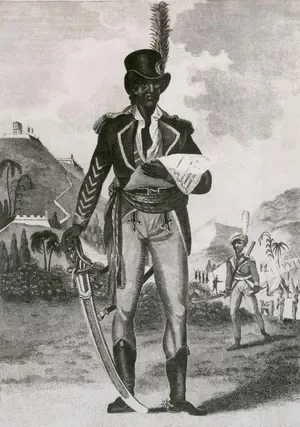
Toussaint L’Ouverture 1795 portrait
Toussaint Breda was born into slavery on a sugar plantation in the French colony of Saint-Domingue, modern-day Haiti, in the early 1740s. He grew from a skinny child to an athletic young man, a strong swimmer and great horseman, which caught the attention of Francois-Antoine Bayon de Libertat, the overseer of the Breda Plantation. Bayon promoted Toussaint multiple times, landing him the plantation steward role.
Toussaint was multilingual, he spoke Fon, the language of his Benin origins, Haitian Creole, and French. His position on the plantation allowed him to receive lessons in geography, history, herbal medicine and mathematics from his godfather Pierre-Baptiste, an educated free man who was taught by the Jesuits. Toussaint’s own education would also lead to his freedom in 1776.
The Lead Up to The Haitian Revolution
Haiti was a ticking time bomb. Four volatile components created a chain reaction that led to the eventual uprising in 1791. Saint-Domingue, named the “Pearl of the Antilles”, was the richest French colony in the world, built by the sheer brutality of slavery, on a scale that had France importing tens of thousands of Africans every year to keep a sizable labour alive.
The island was divided into four highly hostile social groups that consisted of the wealthy white planters who wanted self-rule, poor white tradesmen who hated the wealthy, free Africans who were often wealthy but denied political rights, and enslaved Africans who made up 90% of the population.
The French Revolution of 1789 ended with France declaring that “all men are born free and equal.” When the enslaved population of Haiti heard of this declaration, they rightly questioned why it excluded them. Even the white planters wanted liberty from French rule and taxes.
In August 1791, a high priest named Dutty Boukman held a secret Vodou ceremony at Bois Caiman, uniting enslaved Africans from different tribes and plantations to commit to a single oath to fight for freedom. Just days after the ceremony on August 22, 1791 the enslaved population rose up in massive unified rebellion. They burned sugarcane fields, attacked the slaveholders and destroyed the plantations.
Toussaint the Leader of Haitian Revolution
Toussaint didn’t immediately lead the fight when the great slave uprising of 1791 erupted in Saint-Domingue. With his skills in herbal medicine he learned as a young man, he initially acted as a physician to the rebel forces. But not for the first time in his life, a now 50 year old Toussaint demonstrated his brilliance. He had a natural gift for military strategy and logistics. He was also incredibly charismatic and quite a flamboyant character. He began training a core group of several hundred men in guerilla style tactics and strict military discipline, making his unit far more effective than the larger, uncoordinated rebel bands.
What made Toussaint genuinely extraordinary was not just his ability to fight, it was his ability to think several moves ahead while everyone else was reacting. Saint-Domingue in the 1790s was a geopolitical pressure cooker. Spain, Britain, and France were all competing for control of the island. Planters were fighting commissioners. Mulatto generals were fighting black generals. Royalists were fighting Republicans. Most leaders in this environment picked a side and stuck to it. Toussaint L’Ouverture played the entire board.
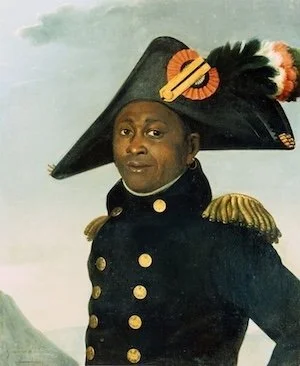
Toussaint L’Ouverture 1813 portrait
He allied with Spain when it served the cause of freedom. He defected to Republican France the moment Paris abolished slavery, not out of loyalty to France, but because the policy matched the mission. He then negotiated a secret trade deal with Britain, restored commercial ties with the United States, and effectively ran an independent foreign policy while nominally remaining a French colony. He was doing all of this simultaneously.
When the British finally withdrew, having lost over 12,000 men, mostly to disease and L’Ouverture's relentless guerrilla campaign, it was not a lucky escape. It was the result of deliberate, sustained strategic pressure from a man who understood that you don't always have to win every battle. You just have to make the cost of staying unbearable.
A French colonial general, Étienne Laveaux, observing Toussaint's military brilliance, reportedly said in frustration that Toussaint Bréda always managed to find an ouverture (French for "opening") in enemy lines, no matter how the French forces were positioned. As the ultimate flex but more importantly to symbolise what he could do for his people, Toussaint changed his last name to L’Ouverture.
Toussaint and Napoleon’s Betrayal
Napoleon Bonaparte saw Toussaint L’Ouverture’s rise to power as a direct threat to French rule, especially after Toussaint drafted the 1801 Constitution that abolished slavery and named himself Governor-General for life. Enraged by his audacity and defiance, Napoleon launched the largest overseas military expedition in French history, sending his brother-in-law, General Charles Leclerc, with tens of thousands of elite troops to reclaim the colony, disarm the population, and secretly lay the groundwork to restore slavery. After months of brutal, scorched-earth warfare, Toussaint agreed to a conditional surrender in May 1802 under the false promise of safety. However, the French betrayed him just weeks later; he was ambushed at a meeting, arrested, and deported to France, where Napoleon had him locked away without trial in the freezing, isolated cells of Fort de Joux, where he died of pneumonia April 7th 1803.
Napoleon, still underestimating Haitian Africans, thought that eliminating Toussaint would crush the rebellion, but the strategy backfired entirely. Toussaint's top general, Jean-Jacques Dessalines, smartly realised that Napoleon intended to re-enslave the population, so he united the revolutionary forces in a war of total extermination. Combined with a devastating outbreak of yellow fever, Haitian guerrilla tactics utterly decimated the French army, forcing Napoleon to abandon his dream of a Western empire and famously sell the Louisiana Territory to the United States.
The Revolutionary Toussaint L’Ouverture
Toussaint L’Ouverture was the architect of one of the most consequential events in the history of the modern world. The first Black republic in the Americas, the only successful slave revolution in recorded history. The ideals of the French Revolution, liberty, equality, fraternity, were always going to be tested by the existence of colonial slavery. Toussaint L’Ouverture understood that for his people, freedom was never just going to be given, so it had to be taken.