

Hidden in Plain Sight: Black Figures in British and European Art,1500-1650
As part of our Black Tudor series, we highlight the representation of Black people in art from the 1500s to the 1600s. While many of these figures remain unidentified and are often depicted in secondary roles, such as Oliver Cromwell's African attendant, there are notable instances where Black individuals are the central subjects.
These rare depictions offer valuable insights into how Black figures were portrayed within the societal, cultural, and political dynamics of Tudor Britain. By exploring the historical presence of Black individuals in this era, we challenge modern misconceptions of Tudor Britain and the rest of Europe as racially homogenous societies.
John Blanke, Westminster Tournament Roll, 1511 (Unknown Artist)
Of all the Black figures captured in art during the Tudor period, John Blanke is the only one we know by name.
A royal trumpeter in the courts of both Henry VII and Henry VIII, Blanke appears twice in the Westminster Tournament Roll, a 60-foot painted vellum record of the 1511 jousting tournament celebrating the birth of Henry VIII's son. Among the procession of trumpeters, he is immediately distinguishable. Not only by his skin tone, but by his headdress, a multicoloured patterned cloth thought to indicate Islamic faith or cultural heritage, suggesting origins in North Africa or the Iberian Peninsula.
His presence in the Roll speaks to his standing. Portraiture in early Tudor England was reserved almost exclusively for royalty and nobility. Blanke also petitioned Henry VIII directly for a pay rise, and got it, with his wages doubled from 8 to 16 pence a day. A Black man, negotiating his worth with the King of England, in 1510.
He remains the only Black Tudor for whom an identifiable image exists. That image alone has helped rewrite what we thought we knew about race, presence and belonging in early modern England.
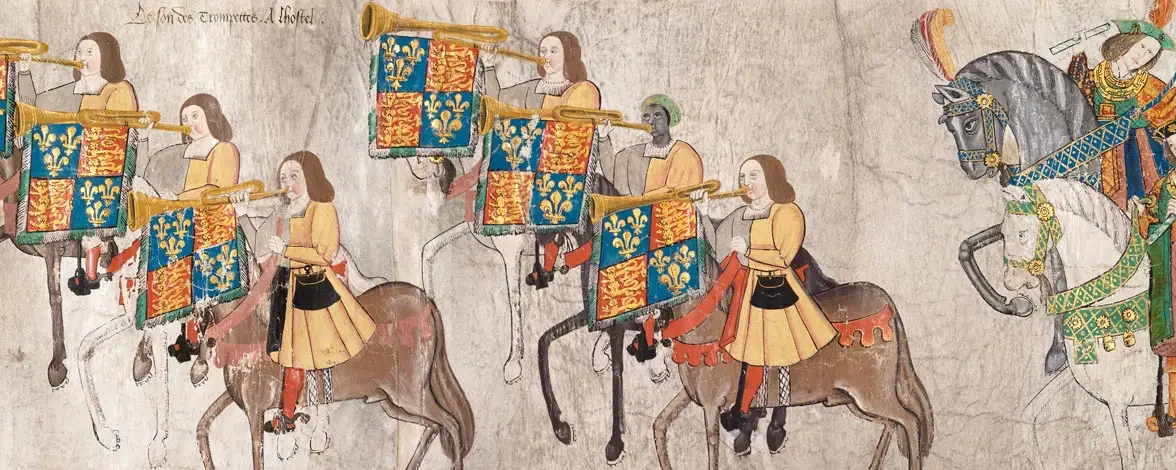
John Blanke, Westminster Tournament Roll, 1511 (Unknown Artist)
The Penshurst Boys, 1626 (Unknown Artist)
Housed at Penshurst Place in Kent, a former hunting lodge of Henry VIII, this 1626 portrait is believed to be one of the earliest known full-length depictions of a Black individual in British portraiture. The painting features two teenage boys, one of African heritage, painted at the same scale as his white counterpart. Equal in size. Equal in presence.
What makes this portrait exceptional is precisely that equality. Michael Ohajuru, senior fellow at the Institute of Commonwealth Studies, describes it as "exceptional" for a painting of this age to show a Black figure "at the equivalent size" to white counterparts, a deliberate artistic choice that speaks to the subject's status and standing.
The identities of both boys remain unknown. The painting has been at Penshurst since at least 1743 and on public display since 1947, yet it is only recently that the right questions have been asked. The National Portrait Gallery has now launched a major research project, drawing on dress historians, hunting historians, genealogists and family historians to uncover who these boys were. The painting goes on display in London from September 2026.
Its significance extends beyond Britain. Ohajuru notes the research will "have an impact in terms of the Black presence in Europe in that period and even later" — adding another vital piece to a history that has long been hiding in plain sight.
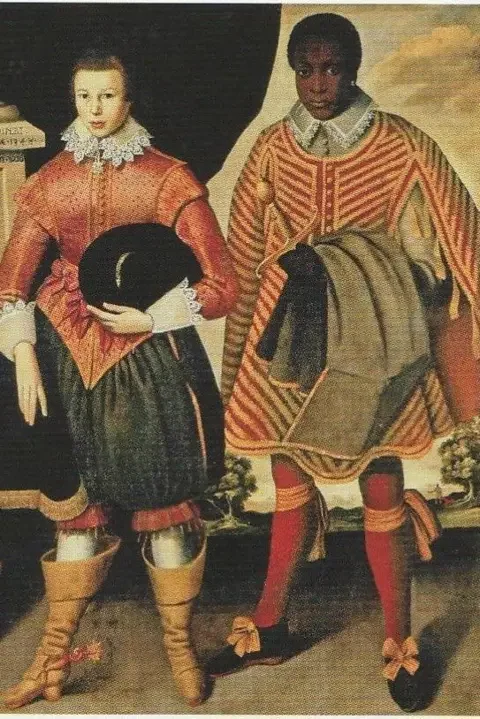
The Penshurst Boys, 1626 (Unknown Artist)
Portrait of a Moor, c1525-30 (Jan Mostaert)
Jan Mostaert’s Portrait of a Moor (c. 1525-30) is notable for its rare depiction of a Black man as the central subject in European art of the early 16th century. This portrayal challenges the typical representation of Black individuals during that time, who were often shown as servants or exotic figures. Mostaert instead presents his subject with dignity and respect, suggesting the man was likely a nobleman or of significant social standing.
The figure is dressed in elaborate, regal clothing, including a feathered cap and richly adorned tunic, indicating wealth and prestige. This respectful depiction contrasts with many European portrayals of Africans, emphasising the subject’s autonomy and authority. The painting also reflects the presence of Africans in early modern Europe, a result of increasing cultural and commercial exchanges between Europe and Africa.
The identity of the man remains unknown, adding an air of mystery to the portrait. This lack of information underscores broader issues of erasure and marginalisation of Black individuals in European historical records. Ultimately, Portrait of a Moor is a powerful representation that challenges stereotypes and provides a glimpse into the diversity and complexity of European society during the Renaissance.
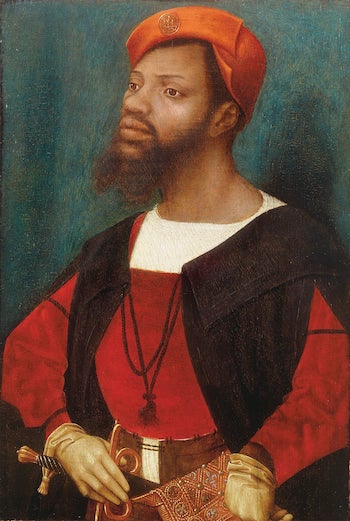
Portrait of a Moor, c1525-30 (Jan Mostaert)
Los tres mulatos de Esmeraldas, 1599 (Andrés Sánchez Gallque) is one of the earliest depictions of Afro-Indigenous figures in Latin American art. It portrays Don Francisco de Arobe and his two sons, Pedro and Domingo, leaders of the Maroon community in Esmeraldas, Ecuador. These men of African and Indigenous descent symbolise the unique cultural blend of African and Indigenous identities that emerged through intermarriage in the Americas.
The painting marks a significant historical moment: the formal submission of Don Francisco and his sons to Spanish rule. Despite this act of submission, the men are depicted with dignity and authority, dressed in luxurious Spanish clothing that conveys their high status. Their confident poses suggest pride in leadership, contrasting with the often dehumanising portrayals of Black and Indigenous figures in colonial art.
As a visual record of mestizaje (racial and cultural mixing), the painting reveals the presence and leadership of African-descended people in the region. Andrés Sánchez Gallque, an Indigenous artist from Quito, uses a blend of European Renaissance techniques and Indigenous styles, creating a work that reflects both colonial power dynamics and Afro-Indigenous agency. This painting remains a vital historical resource, highlighting the roles of African and Indigenous peoples in shaping colonial Latin America's political and cultural landscapes.
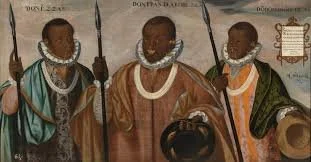
Los tres mulatos de Esmeraldas, 1599 (Andrés Sánchez Gallque)
A Billman ‘able for war’, 1522 (Peter Blackmore)
One of the most significant aspects of The Billman ‘Able for War’ is its depiction of a Black man as a foot soldier in Tudor England, challenging the misconception that Black people were rare or absent during this period. The painting highlights the diversity of early 16th-century England and suggests that Black individuals participated in military and civic life.
The figure is shown as a fully armored soldier holding a bill, a polearm used in close combat, not as a servant or exoticized figure, as was common in European art. This portrayal emphasizes that Black individuals could hold positions of responsibility and integrate into English society, offering a broader understanding of their roles beyond narratives of enslavement or subjugation.
As a rare document of Black Tudors, this painting serves as valuable historical evidence of their presence and contributions. The armed and respected status of the soldier implies social standing and challenges simplistic racial hierarchies of the time. The context of 1522, a period of military mobilization under Henry VIII, further underscores the soldier’s importance in defending the realm. By depicting a Black man as a soldier, the artwork disrupts modern misconceptions about race in Tudor England and reflects the broader African presence across Europe during the Renaissance.

A Billman ‘able for war’, 1522 (Peter Blackmore)
Adoration of the Magi, Spain c1514 (Gregorio Lopes)
Gregorio Lopes' Adoration of the Magi (c. 1514) is notable for its blending of Spanish, Portuguese, and Flemish influences, making it a key work in Iberian Renaissance art. The painting depicts the biblical scene of the Magi visiting the infant Christ, a central moment in Christian tradition. Lopes’ rendition connects viewers to the religious and cultural context of the time, a recurring subject in Christian art.
Created in the early 16th century, this painting reflects the transition from Gothic to Renaissance styles, incorporating Northern European realism with Italian techniques. Lopes employs perspective to create depth and dynamism in the composition, with architectural elements enhancing the spatial arrangement of the figures. The detailed depiction of garments, jewels, and gifts demonstrates Flemish influence and meticulous craftsmanship.
Symbolically rich, the painting emphasizes the universal significance of the Magi’s gifts—gold, frankincense, and myrrh—representing Christ's kingship, divinity, and future suffering. Lopes captures the reverence of the Magi, Mary, and Jesus, infusing the scene with emotional and spiritual depth. As a court painter, Lopes shaped Portuguese art during the Renaissance, contributing to its national identity by blending local traditions with broader European trends. His Adoration of the Magi stands as a testament to Iberian art's rich religious and artistic heritage.

Adoration of the Magi Spain c1514 (Gregorio Lopes)
Portrait of a Moorish Woman, 1528–1588 (Paolo Veronese)
Paolo Veronese’s Portrait of a Moorish Woman (1528–1588) is compelling due to its rare depiction of a Black subject in Renaissance art. In a time when portraits of non-European individuals were uncommon, Veronese highlights Venice’s diverse population, influenced by its strong trade ties with Africa and the Middle East.
Unlike the stereotyped depictions of Black people in Renaissance art, this woman is portrayed with dignity, grace, and individuality. Her elaborate clothing and jewelry suggest wealth and high status, challenging typical portrayals of Africans as servants or curiosities. Veronese treats her with the same respect given to European sitters, implying she held a significant position, possibly within Venetian aristocracy.
This portrait reflects the multicultural nature of Venice, a trade hub where Africans, Moors, and others interacted. It also subtly challenges the racial hierarchies of the time by presenting the subject with humanity and respect. The work symbolizes Venice’s openness to foreign influences and the social mobility of non-European peoples in its society.

Portrait of a Moorish Woman, 1528–1588 (Paolo Veronese)
Knowledge is power, and context is essential. Africans have been travelling the globe for centuries, and while much evidence has been lost or obscured, significant traces remain to tell these stories. By contextualising the narratives within these paintings, we can uncover hidden parts of history and challenge incomplete narratives. Ultimately, highlighting the historical context of art deepens our understanding of the artwork and its broader significance, allowing us to connect with the past in more meaningful and informed ways.
